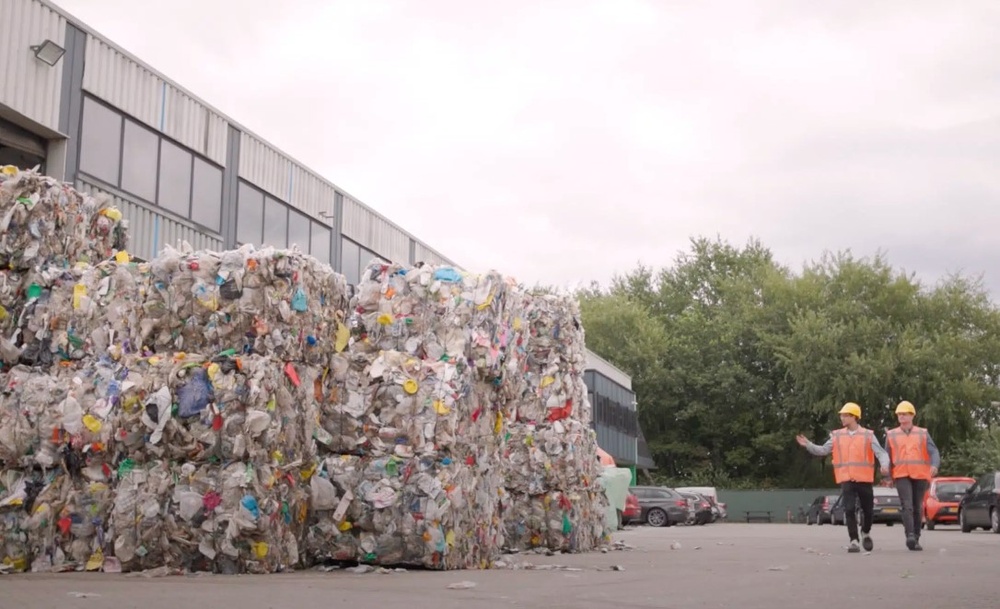
Scaling up plastic recycling remains challenging despite Europe’s circular ambitions.
Rotterdam, The Netherlands, 18 August 2026 – Europe aims to increase the use of recycled raw materials and reduce its dependence on new fossil-based resources. Chemical recycling can play an important complementary role in this transition, particularly for mixed or contaminated plastic waste streams that are difficult to recycle mechanically. In practice, however, the step from technological development to sustained, commercially viable production at industrial scale remains complex.
Research by the European Commission’s Joint Research Centre shows that chemically recycled plastic in Europe currently cannot yet be produced at the same cost as new plastic made from fossil-based feedstocks. High investment and production costs, technical scale-up and competition from virgin plastic all play an important role. Market data also point to a slowdown in the transition: according to Plastics Europe, annual growth in circular plastics production in Europe fell from 13.6 per cent in 2022 to 1.2 per cent in 2024
Against this backdrop, a new destination is now being sought for the recycling plant of CCT Circular CleanTech B.V. in Rotterdam’s Botlek industrial area. The facility was designed as a test and demonstration plant for processing plastic waste through pyrolysis. Over the past few years, the plant achieved a number of important technical results. More than 1,200 tonnes of pyrolysis oil were produced and successful production runs were carried out at industrial scale. In the process, plastic waste was converted through pyrolysis into pyrolysis oil, which can be reused as a feedstock for the production of chemicals and new plastics. Despite these results, the plant did not achieve sustained, stable production at the originally intended commercial scale.
From innovation to industrial scale
The CCT case is not an isolated one. In a relatively short period of time, Troostwijk Auctions has also been involved in the sale of assets from Dutch plastic recyclers Umincorp and Fuenix Ecogy. The circumstances and recycling technologies used differ from one company to another, but together these sales illustrate how complex the transition from innovation to a commercially viable industrial operation can be.
“Europe wants to accelerate the transition towards a circular plastics value chain, but industrial reality remains challenging,” says Ward van den Boorn, Country Director Netherlands at Troostwijk Auctions. “In a relatively short period of time, we have seen several Dutch recycling plants come onto the market. The circumstances are different in each case, but they show that the step from innovation to profitable large-scale production is not yet a given. At the same time, these facilities represent significant technical and economic value that can be put to use elsewhere.”
This also creates a new circular opportunity. Facilities originally developed to turn waste streams back into raw materials do not have to be lost when business activities come to an end. Reusing complete plants or individual machines can prevent relatively young and specialised industrial assets from being written off prematurely.
A second life for recycling technology
For the CCT plant, a buyer is being sought who can give the facility as a whole a new purpose. At the same time, its key components are also being offered separately.
“The most circular scenario would be for another party to continue operating or adapt the plant as a whole,” says Sjoerd Baars, Team Lead Insolvency at Troostwijk Auctions. “But even if the facility is split up, relatively young and specialised machinery can be put back into use. In this way, the technology that was developed to give plastic a second life can itself be given a second life.”

Coperion GmbH ZSK 133 Mc Plus extruder from 2022
The facility includes two extruders from 2022, a batch reactor, a tank farm, process equipment, central electrical rooms, three transformers, a bunker installation and an industrial cooling unit. Potential buyers are not limited to the plastic recycling sector. Individual components may also be suitable for use in the chemical industry, process industry, waste processing and the production of circular raw materials.
Sale of complete plant and individual components
The complete facility is being offered through a direct sale process. In addition, companies can bid on nine major industrial lots through an online auction organised by Troostwijk Auctions.
Location: Rotterdam Botlek, The Netherlands
Direct sale and online auction close: 14 September 2026 at 4.30 pm
Viewing: via 3D tour